

Published June 23Edited July 8
Short-form clips excerpting podcasts, television shows, movies and news broadcasts are everywhere. As a recent NPR interview asked, are these clips creating value for audiences and creators — or primarily for the people repackaging and distributing them?
This question points to a larger problem: For too long, we’ve been conflating the journalism business with the media business. Fuzzy terms like “news,” “content” and “publishing” are often used interchangeably, and both businesses primarily monetize their “content” through ads and subscriptions.
Further complicating matters is the fact that, in an effort to stay afloat, some news outlets have diluted their offering to include some journalism and lots of other, less expensive forms of content.
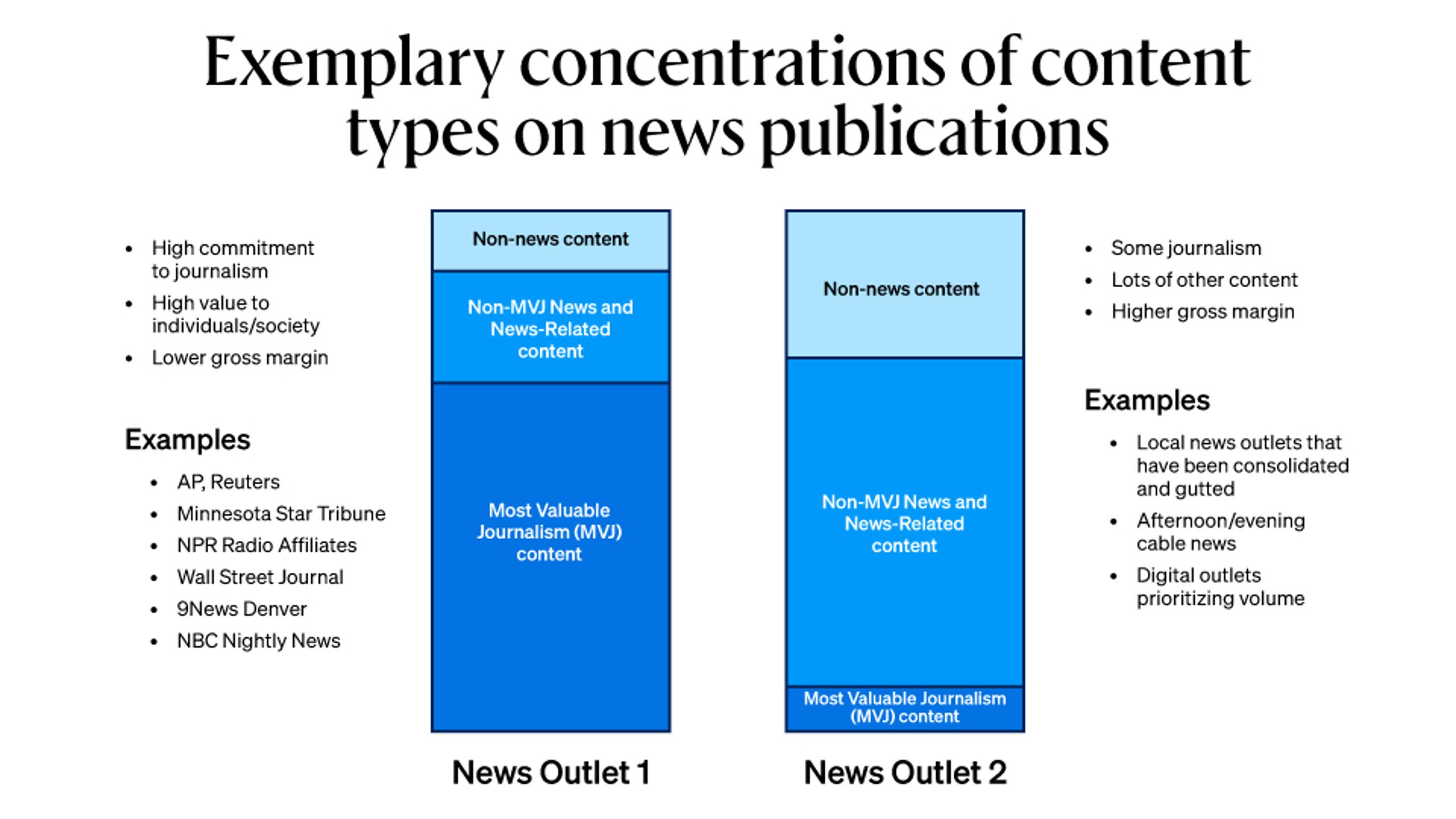
But media and journalism are fundamentally not the same businesses. And we all lose if we act like they are.
Trusted journalism: The MVP of media
“Media” is a broad term that includes journalism, but it refers to all informational, educational or entertainment content. Clips are media. Content about clipping is media. In an M.C. Escher-like example of content begetting content, one clipper, Emrah Bayraktar, has amassed over 1 million followers across six accounts. Each teaches people how to generate revenue by creating and distributing their own clips.
We’re not lacking for media, yet we collectively lament the “loss of journalism” — the loss of investigative reporting, on-the-ground disaster coverage, local reporting, human interest stories. For shorthand, let’s call this content the most valuable journalism, or “MVJ.”
Unlike quick-turn clipping or spouting off hot takes, MVJ is the most expensive kind of content to create because it requires people going out into the world to gather and verify facts. The problem is that the business model supporting that work has been steadily eroding. Data from the Bureau of Labor Statistics in 2024 found newspapers lost 77% of jobs over the last 20 years.
As journalism jobs and journalism decline, however, the overall volume of other media has been drastically increasing. The cost of creating MVJ is high, but the cost to publish and distribute content has come down drastically because of technology.
Bayraktar’s story highlights how an individual or very small crew can create a successful “media” company that competes for attention and advertiser dollars. As NPR reports, one agency offered a $1 cost per mille (CPM) for clips of Major League Baseball games.
The baseline need for journalism
In view of the market incentives, it’s amazing there’s any journalism left at all. But it still exists because of a baseline need — both individual and societal — for important new information. There will always be a baseline market for attention, and therefore advertising, on journalism.
But we suffer consequences when we fail to distinguish that journalism has a distinct, inherent value that is different from other media. And it’s not just society that needs journalism to function. From a business perspective, advertisers and platforms have an inherent interest in news.
You may have heard that “quality” of media is important to outcomes. “Quality” comprises a lot of things, but the value of the content to its reader is among the most important measures. People need true, new information about important things. They seek it out purposefully and spend time with it; nearly three-quarters of Americans report they follow the news regularly, and 25% self-identify as news junkies. A recent study showed that hard news drives the most local news subscriptions of any type of content, and there’s no clearer signal of what a news reader values than what they pull out their credit card for.
This is the reason that campaigns running on high-quality news consistently outperform campaigns running on non-news media. Stagwell research additionally found that consumer trust rises up to 4 points and favorability jumps 8.4 points when brands advertise on quality news.
Another proof point that journalism holds our interest may be found in the way content proliferates. MVJ serves as the origin for most other news-related media. Without the determined work of local journalist Julie K. Brown of the Miami Herald back in 2018, for example, Jeffrey Epstein would never have been convicted of his crimes. Think of all the subsequent media content the original Epstein article enabled: the follow-up reports, podcasts, YouTube videos, TikToks, Reels.
Consequently, original reporting feeds infrastructure for Google, Meta and other social platforms. And it is glaringly, obviously, the infrastructure for AI. The extent to which other media, tech platforms and AI companies devalue and underpay for MVJ is the extent to which they weaken their own foundations.
What’s next
So what does it mean when we treat journalism like content? It means no one wins: not advertisers, platforms, citizens. But we’re not powerless. All of us can help journalism businesses thrive as much as other media businesses by compensating them for their true value, and we should, because we win if they win.
This op-ed represents the views and opinions of the author and not of The Current, a division of The Trade Desk, or The Trade Desk. The appearance of the op-ed on The Current does not constitute an endorsement by The Current or The Trade Desk.




August 27Max Snow