
Published June 30Edited July 23
This is the first in a three-part series on how AI is changing the ways consumers interact with the web and how advertisers can reach them across commerce, streaming and search.
In March this year, Amazon won a court order to block Perplexity’s AI shopping agent from accessing its website.
Three months later, Amazon touted its own agentic shopping tools.
In June, the tech giant declared that “agentic shopping is here” in a blog post, after launching its AI assistant, Alexa for Shopping, which offers conversational, sponsored ads. More recently, at the Cannes Lions International Festival of Creativity, the company announced Alexa+ Agentic Ads, where users can complete a purchase without leaving the ad.
While that may sound a bit self-serving, it also reflects a larger shift. As AI-assisted shopping gains traction, retailers and brands are going to want to take more control of the consumer journey and nurture their relationships with customers.
But even if presented with the option, are consumers actually ready to complete purchases with AI tools?
“As of now, we’re not seeing a lot of shopping behavior on LLMs,” EMarketer CEO Matthias Braun told The Current. “If anything, [AI users] actually prefer shopping on the traditional search experience or an app.”
Consumers still aren’t sold on AI purchases
It’s clear that consumers are increasingly using AI for retail search and shopping, even if they aren’t quite sold on letting it hit the “buy” button for them.
An April report from Epsilon found that the top use cases for AI-assisted online shopping all involved research and discovery: comparing prices, starting initial research and searching for deals and discounts.
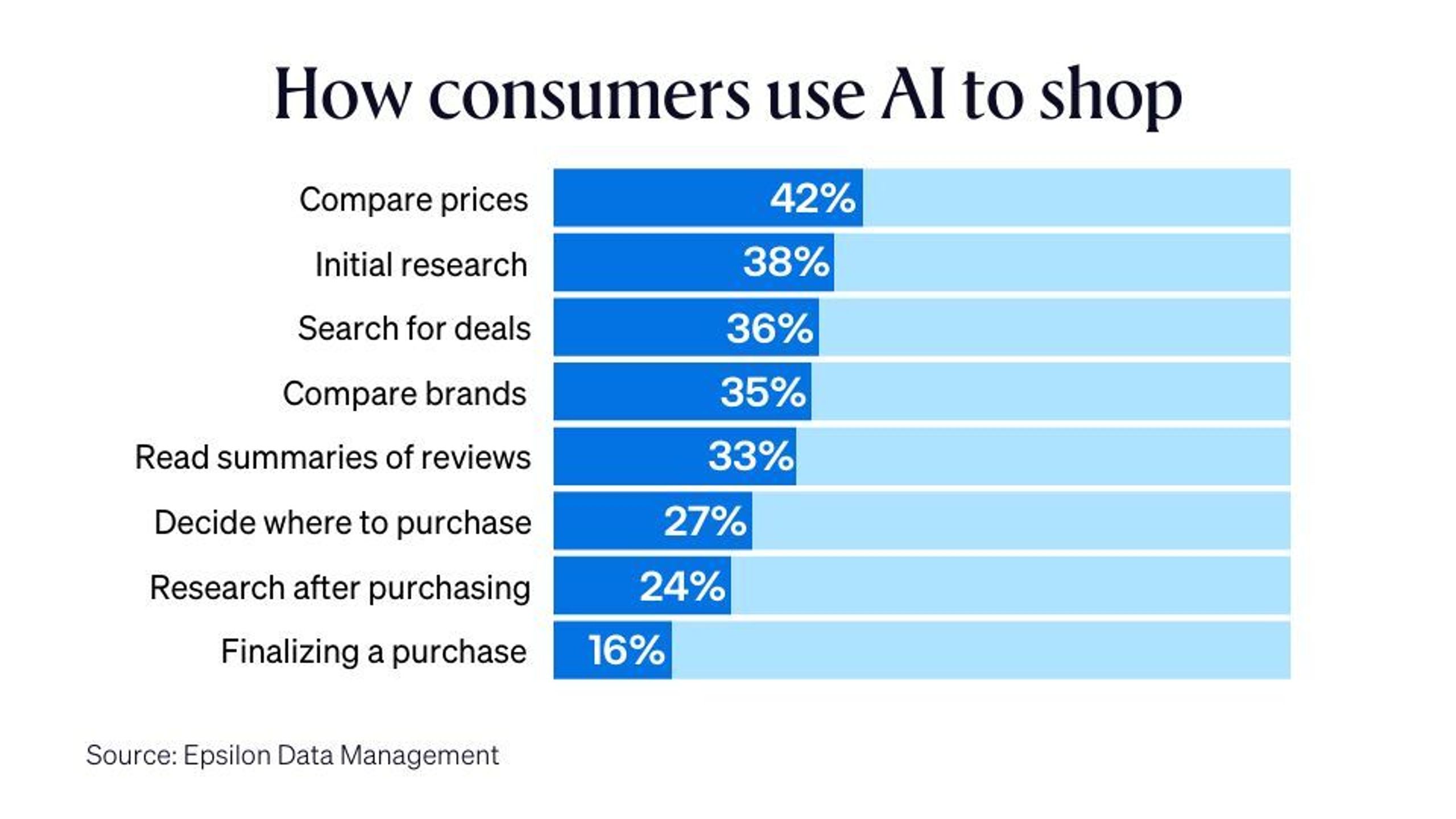
The most likely generation to use AI to help them shop is Gen Z, at 86%, according to Epsilon. But even they are more likely to use it for product information and price comparisons.
Christine Rhea, senior director of acquisition marketing at Away, told The Current that AI platforms becoming the primary point of purchase may be “closer than you think,” but that we’re “not there by any means yet.”
More recent research supports that: A new survey of 3,000 people across the U.S. and U.K. found that 88% of respondents are not fully comfortable using AI tools for big decisions; further, consumers are 1.6 times more likely to finalize a purchase on the open web outside of AI tools.
Another recent survey by Reddit also insisted that half of U.S. shoppers verify AI recommendations on the platform before purchasing, and 1 in 3 do so in the U.K. Convenient data for Reddit, but it is in line with the other research.
That mindset may be tough to change, and it certainly won’t happen overnight.
“[AI] may not book your flights or hotel, but it sure will give you advice on where to stay, what the cheapest flights are. It will automate a lot of that,” Anthony Katsur, CEO of IAB Tech Lab, previously told The Current. “Change of behavior is hard. I think we’ll be in a world of AI-assisted commerce for a while.”
Retailers are increasingly leveraging AI tools, but the above insights suggest that it’s imperative for them to meet consumers at checkout — or any other touchpoint where they’re not using an AI agent.
“A lot of people are asking us about agents buying on behalf of consumers, but that isn’t really happening yet,” Rachel Cascisa, Epsilon’s vice president of platform adoption, said in the report. “Consumers still want to make purchases themselves; they’re not willing to let AI spend their dollars.
“Marketers have a big opportunity to provide value via personalized recommendations and really take advantage of every touchpoint — because it might be the only interaction they get.”
Owning the customer relationship
Some retailers have partnered with AI platforms to varying results.
Earlier this year, Walmart shook up its OpenAI partnership after disappointing sales, Wired reported. Instead of letting users order a limited selection of products directly from ChatGPT, it integrated its own shopping assistant, Sparky, into the app and Google’s Gemini, according to the report.
Target issued a warning to users after a Google Gemini integration, saying that they’d be on the hook for any orders an AI agent mistakenly makes — reflecting how crucial the retailer-consumer relationship is, especially when outsourced to third-party AI platforms. It also suggests that to control the consumer journey, brands may have to control the AI experience.

“Owned experiences give brands and retailers the ability to apply agentic AI in ways that strengthen relationships: guiding customers through complex decisions, resolving service issues proactively and reinforcing loyalty at every interaction,” according to a recent white paper by Commercetools.
“This is where speed can be balanced with trust — and where long-term value is built beyond third-party AI channels.”
Still, if AI-powered commerce is the future, then the entire ecosystem — brands, publishers, retailers and ad tech companies — could learn how to better partner together to reach shared goals. Shopsense AI’s new CEO, Bryan Quinn, for instance, is aiming to bridge those worlds, betting on the company’s shoppable intelligence to analyze and match products to appropriate webpages.
“There’s more of an expectation around consumers that shopping can occur anywhere,” Quinn told AdWeek. “[Publishers] are looking to either create new experiences or try and connect advertising dollars to make it more relevant.”