
June 2
When Alberto Horihuela was growing up in Old Havana, Cuba, there was a mango tree deep inside a military base near his neighborhood. The base was closed to the public, but the kids knew about the tree. Every summer, Horihuela and a friend would sneak in, hiding in the bushes whenever soldiers walked by, just to grab the mangoes. He never appreciated at the time how reckless it was. “Bravery and stupidity,” he said, “weren’t all that far apart.”
In 2001, at the age of thirteen, he arrived in Louisville, Kentucky with his mother, speaking no English. An aunt already settled there said there were jobs, and that Kentucky was up and coming. Nobody in the family, Horihuela suspects, realized just how far Louisville was from Florida—where most Cuban immigrants landed. On the first day of school, he took the wrong bus to the wrong school. He couldn’t find his name on the board and struggled to ask for help in English. He found the right school the next day.
On a recent afternoon, 25 years later, Horihuela was walking the corridors of Fubo, the sports streaming platform he co-founded in 2015, when he stopped to talk to The Current. He greeted two co-workers by name—colleagues from the early days—who joked with him. He was wearing a plaid shirt and gray sneakers. He is now thirty-eight and the company’s COO. He does not have an office and prefers the bullpen.

In October 2025, the Walt Disney Company acquired a majority stake in Fubo. Horihuela thinks of the moment as a beginning, not an end. With Disney’s reach and capital behind the company, he sees Fubo becoming the dominant live TV streaming platform in America—a direct challenger to YouTube TV.
He credits an old Windows 95 computer with getting him started decades earlier, back in Louisville. He taught himself to code, eventually helping local businesses and newspapers launch online editions. A local paper ran a story about the immigrant kid building websites. This was, he noted, pre-Facebook.
Horihuela ended up at the University of Chicago by chance, following a high school crush who had applied there. She didn’t get in. He did. On his first assignment—a paper on The Iliad—his professor scrawled: “Perhaps you should consider another university.” He called his mother. She told him to come home. Instead he stuck it out, graduating with a degree in economics. “The University of Chicago has this saying,” he recalled: “Where fun goes to die.”
After graduation, he headed for Wall Street—eventually landing at Morgan Stanley as an economist, but the desire to build something tangible never left. When a college friend, Sung Ho Choi, recruited him to help at a small streaming startup called DramaFever, Horihuela began showing up on Sundays, unpaid, off the books. A few months later, he quit Morgan Stanley and joined full time. It was also where he met David Gandler.
One day, Gandler leaned over their adjoining desks. “Alberto,” he said, “what do you think about a Netflix for soccer?” Horihuela’s response was immediate. “David,” he said, “that’s a terrible idea.” Gandler pushed back.
"Bravery and stupidity weren’t all that far apart.”
There were no numbers on American fandom. So Horihuela found them a different way—by measuring piracy. The pirate sites for European leagues told him what the official channels wouldn’t. In aggregate, the U.S. was already one of the largest soccer markets in the world. Millions of Americans wanted to watch Liverpool F.C. or Real Madrid. They just had nowhere legal to go.
That weekend, at a Halloween party, Gandler met their first investor. There was no deck, no website, no business plan.
The three of them—Horihuela, Gandler and Choi—set up an office in Horihuela’s fourth-floor Midtown walkup and started making calls: beIN Sports, Fox, Disney, ESPN. “What’s a Fubo?” asked one executive. Sung, who was sleeping on Horihuela’s couch at the time, remembers the reception as something less than warm.
-
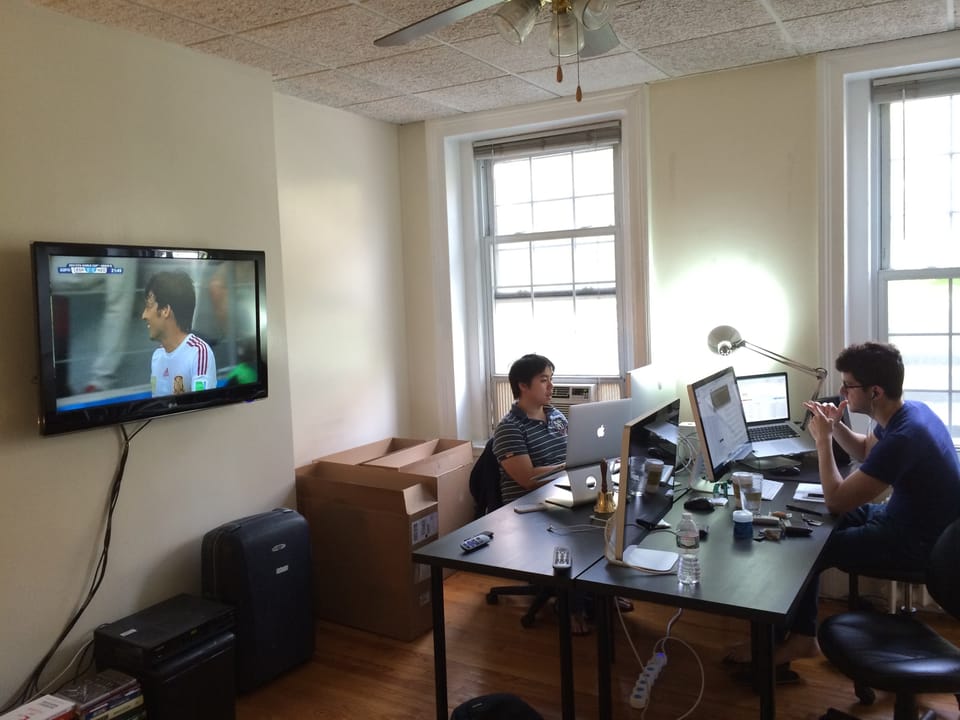
Horihuela's apartment was Fubo's first office
Courtesy Alberto Horihuela -
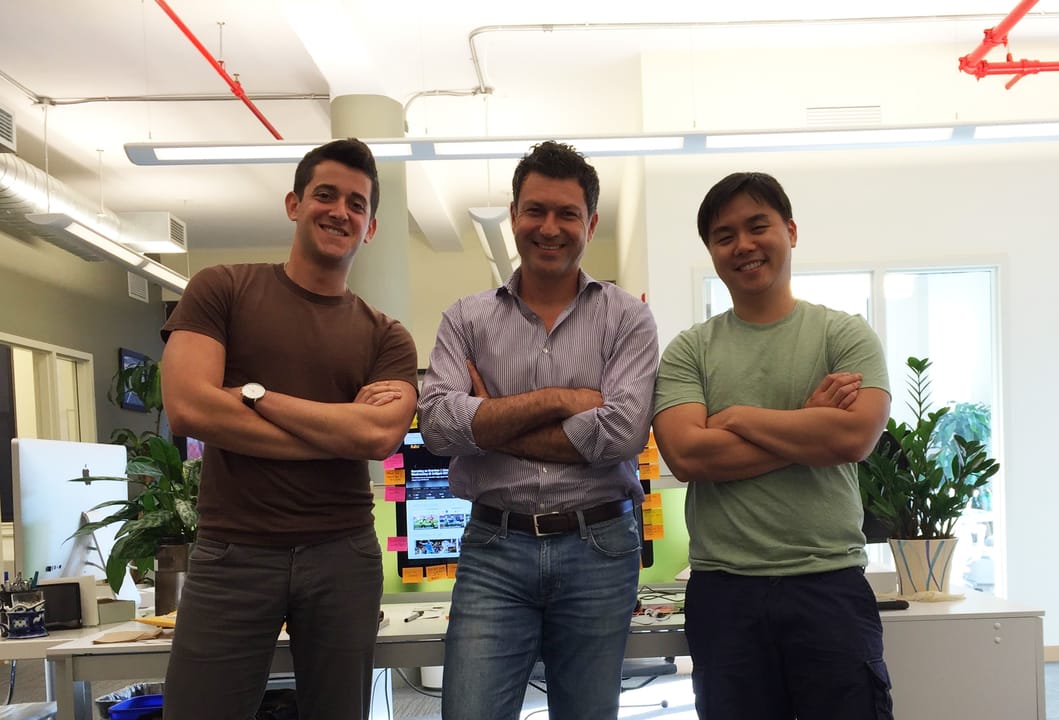
(from left): Horihuela, Gandler, Choi
Courtesy of Alberto Horihuela
Unfazed, they focused on smaller channels, eventually cutting a deal to air ten Bundesliga games—Germany’s top soccer league—featuring Bayern Munich and Borussia Dortmund.
Their entire engineering department was Choi. The night before their debut stream, he was reading Wikipedia entries to figure out how to broadcast live.
When the moment arrived, they hit play. Nothing happened. The screen remained black. All they could hear was the Final Fantasy victory sound they’d rigged to play every time a new subscriber joined. It kept playing. For twenty minutes, as subscribers kept coming, Choi ran around trying to fix the stream. It was not an auspicious start.

Then the green pitch appeared. They feared the worst, expecting angry emails. Some were. But buried among them there was another message: Please don’t give up. What you’re doing needs to exist. Keep going. Horihuela looked over at his inbox. “Holy crap,” he thought. “We have product-market fit. This is the thing we’ve been dreaming of.” One of their first subscribers, it turned out, was the CTO of Amazon, who apparently had been looking for somewhere to watch German soccer.
Choi put it simply: “I think it’s remarkable that Fubo even exists. We were the only startup in this space, and we are the only startup in this space for a reason.”
They kept plugging away, pitching NBC, Fox and other major operators with a simple proposition: let us take your content and sell it digitally through a virtual bundle. “You guys tell us whatever it will take,” Horihuela said, “and we will do it.” It worked. Slowly. Five years after founding Fubo, on October 8, 2020, they took the company public on the New York Stock Exchange. The pandemic was still in its early days. Cord-cutters looking to save money found Fubo—by now carrying hundreds of channels across sport, news and entertainment—and stayed.
Horihuela, who built a company around European football, likes to box. He doesn’t play soccer. Fandom, for him, is less interesting than the gap in the market. “I would rather hire a physicist to do marketing than a brand marketer,” he said. At Fubo, PhDs in astrophysics optimize the recommendation engine.
As he returns to the bullpen, he passes a giant LED screen streaming a boxing match. Now, with Disney as majority owner and Gandler still as CEO, Horihuela has his eye on what’s next. AI, he thinks, is about to remake linear television in ways the industry hasn’t yet imagined. He envisions a system that watches the news on your behalf, labeling and categorizing stories so that when you turn on your TV, you only see what matters to you. “There’s been very little disruption on television with AI,” he said. “We’re just getting started.”
Back in Kentucky, his mother watches Fubo constantly, especially the Spanish-language channels. His whole family uses his account, he admits. “I open Fubo,” he said, “and it's wall-to-wall Spanish novelas.”