

November 3
Here’s an uncomfortable truth about the AI revolution: Most companies are investing in the same technology, training on much of the same information and expecting dramatically different results.
Think about that for a minute.
If your competitors have access to the same AI models you do, what exactly gives you an advantage? The answer is the one thing they can’t easily replicate: what you know about your customers.
Models are only as good as the data that fuels their decisions.
Because every major LLM is trained on publicly available information, relying on them alone provides little competitive differentiation. Data efficacy typically follows an S-curve. Initially, adding more data delivers modest improvements. As the volume and quality of data increase, performance accelerates. Eventually however, the gains begin to flatten.
And if everyone is drawing from essentially the same pool of publicly available information, everyone eventually runs into a similar ceiling.
That's why I believe the next competitive advantage in AI will come from the proprietary intelligence companies bring to the technology and the relationships they build to expand it.
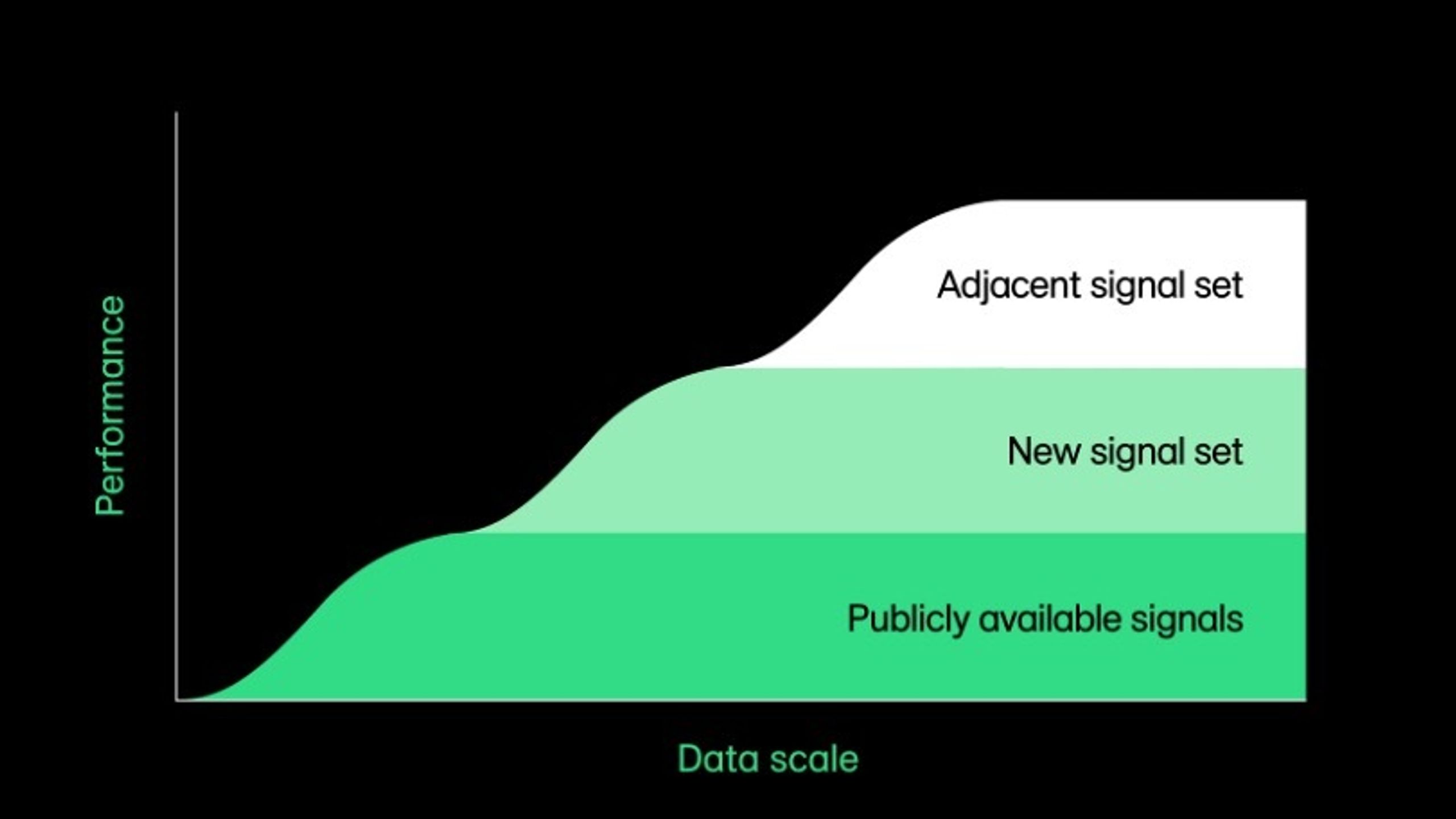
As Microsoft’s Satya Nadella wrote in 2024 “As AI becomes more capable and agentic, the models themselves become more of a commodity, and all value gets created by how you steer, ground and fine-tune these models with your business data and workflows.”
Your data is your advantage. So do something with it.
Your competitors can’t copy what only you know
Here’s what surprises me: Even with all the investment in AI, many marketers still aren’t fully using the customer intelligence they already possess. That’s a missed opportunity, especially when activating first-party data across DSPs, CTV, social platforms and other touchpoints can deliver triple-digit performance lifts compared with more commoditized targeting approaches.
And don't stop with what you already know. Enrich that intelligence with second and third-party data where it makes sense, using clean rooms, encryption and contractual safeguards to protect your competitive advantage.
Your next advantage may belong to someone else
Here’s where I think companies are thinking too small. They assume their competitive advantage is limited to the information they already own. But some of the most valuable things you could know about your customers are sitting inside someone else’s business.
Consider a retailer and the packaged goods sold on its shelves.
The retailer understands shopping behavior and patterns. The brand brings a different understanding of its customers. When those companies securely collaborate, they can uncover insights neither could discover independently. Two companies, each with an incomplete picture of the customer, can come together and discover something neither knew before. That’s creating intelligence. And in an AI-powered world, that intelligence becomes exponentially more valuable.
The best partners won’t be available forever
Think back to the 1980s and ‘90s, when airline loyalty partnerships were forming. Initially, the proposition was pretty simple: Fly with us, earn miles, get a free ticket. Then airlines realized their relationships with customers extended far beyond the airplane. Those customers stayed in hotels, rented cars and used credit cards.
By building partnerships across those businesses, airlines transformed simple rewards programs into powerful ecosystems that created value for everyone involved.
There’s a lesson there for the AI era. The companies that recognize the value of complementary partnerships early can build advantages that become increasingly difficult for competitors to replicate. The difference today is speed.
Partnerships that took years to build into competitive advantages in the past could become essential to AI performance much faster.
Here’s my prediction
Five years from now, the companies winning with AI won’t necessarily be the ones that invested the most in models or hired the most AI engineers. They’ll be the ones that recognized the value of their proprietary data, figured out how to connect it with complementary intelligence and built the partnerships to make it happen.
The race to secure those advantages is already underway. And the best partners won’t wait forever.
This op-ed represents the views and opinions of the author and not of The Current, a division of The Trade Desk, or The Trade Desk. The appearance of the op-ed on The Current does not constitute an endorsement by The Current or The Trade Desk.
At the recent ANA conference in Orlando, Matt Prohaska observed fewer publishers in attendance than ever before.
November 2Matt Prohaska

The dog, not the tail: Who really controls the media dollar?
October 29Sir Martin Sorrell
The case for the Open Internet.
October 27Jeff Green