

November 11
Throughout my life and since a young age, I’ve always been the one to point out the elephant in the room.
Sometimes there is an undercurrent to the status quo (and the things said about it) that makes the conversation and situation incomprehensible until someone surfaces the thing that is NOT being said. And often, the thing not mentioned, acknowledged, or even noticed is the force that is creating that undercurrent.
I think we’re in one of those moments in advertising.
Over the last year and a half, I’ve met with over 100 experts in the measurement space and those affected by it—agencies, media companies, MMMs, retailers, and more. One of the most memorable discussions was with Michael Farmer. He’s a professor, consultant, CEO, author—and a genuinely insightful and straight-shooting advertising expert with lots of opinions.
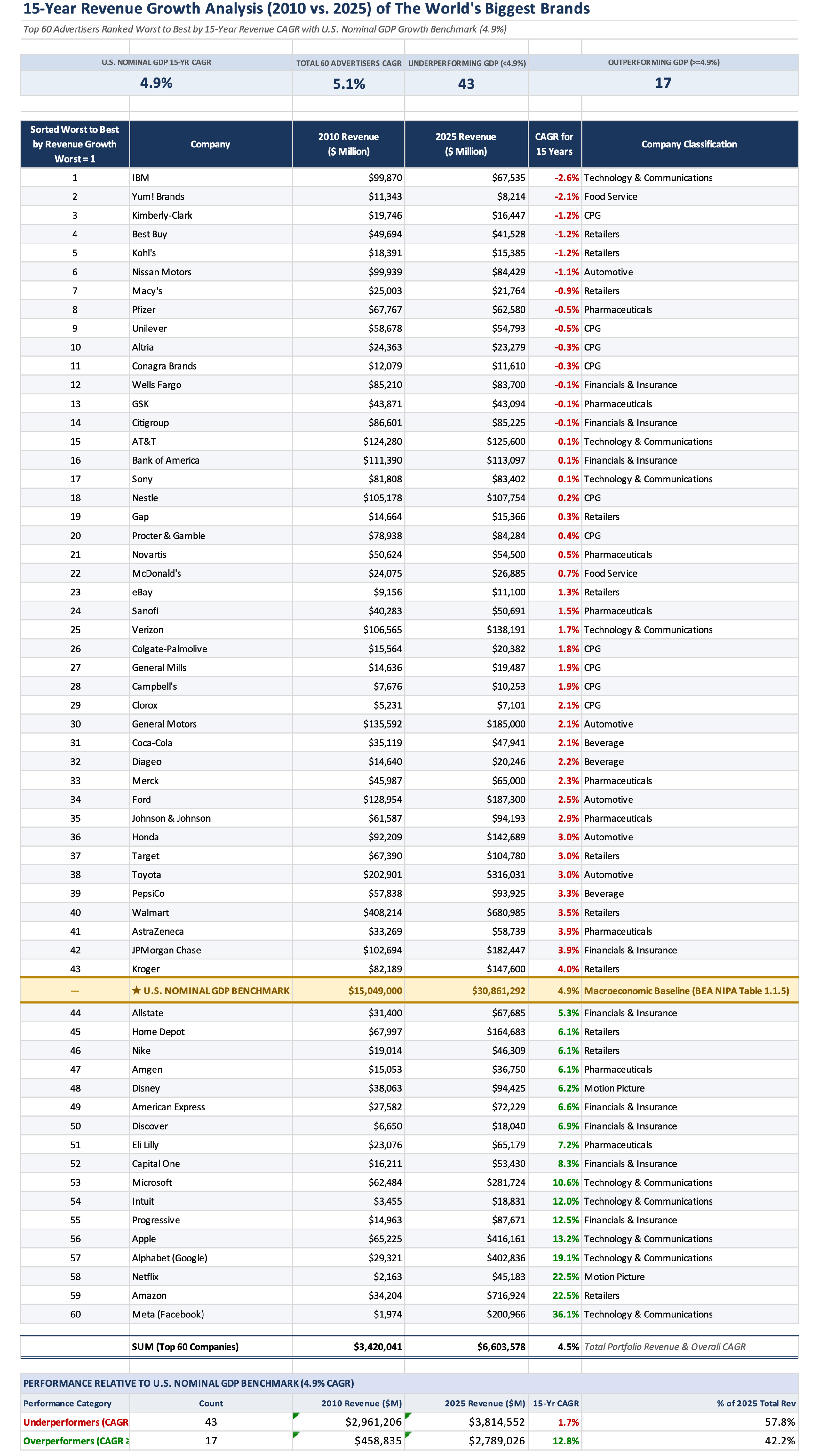
Michael analyzed the growth of the world’s top 60 brands over the last 15 years, a period marked by the rise of digital and programmatic advertising.
His analysis found that roughly two-thirds of these brands have not kept up with nominal GDP.
Here is my updated version of the chart he initially assembled:
He and I spent a lot of time discussing one big question: why are the majority of the world’s largest brands not growing?
Of course, there are many forces at work, including the following highlights from our discussion:
All CPG brands performed below nominal GDP and real GDP.
Relative to other categories, Finance, Entertainment, and Tech mostly won.
From any view, CPG, Automotive, Food, and Beverage mostly lost.
But on the whole, after excluding the top 5, average growth above nominal GDP was close to zero.
Two of the biggest and most notable winners have been Google and Meta. Their growth is impressive. Meta’s distance from the pack is shockingly good, but that brings us to the elephant in the room.
Most big brands are not growing.
They’re not growing in part because they don’t brand-build like they once did. In recent years, many brands have lost sight of what drove their success in the first place.
The heavy lifting of brand building has always been done by putting premium video and audio ads into premium content. Exceptional advertisers are fluent in the principles of Byron Sharp’s core curriculum book, How Brands Grow.
Great marketers and advertisers understand that making someone feel something is critical to building a brand. Sharp talks about the importance of aiming for memory, not just attention. He makes clear that to influence behavior, advertising must engage with people’s memories. Great ads create associations with memories that cues can later activate, bringing a brand to mind when it matters.
As another industry expert in measurement and ad effectiveness, Andrew Tindall, Chief Growth Officer at UK-based System1 Group said to me recently, "If brands want to sell more, make them feel more." Andrew is among the best spokespeople working in the brand-building industry today.
This principle of building emotional hooks to create brand associations has been ignored, sometimes unintentionally, as some marketers have pursued cheap reach and advertising platforms dominated by user-generated content, such as social and YouTube.
Because as Michael Farmer has highlighted, "Cost reductions have been the engine of increased shareholder value for advertisers. Advertisers have shored up their shareholder value metrics by squeezing their agencies…"
Cost has been the obsession. Growth should be.
Farmer added, "Advertisers need help in growing their brands. Brands, which grew strongly up to 2009 have since languished. The lack of brand growth has pushed major advertisers into 'cost reduction modes'."
All great brands were built by using memory structures created through experiences (usually ads) that make people feel something.
Jeff Tetrault is the CEO of Dumbstruck, an amazing AI company that observes human attention and emotional responses to advertising and produces emotion analytics and creative intelligence that brands use to make better ads. He highlighted to me that most TV ads (the foundation of most brand building) reach their emotional apex around the 20-23 second mark. Storytelling that centers around human connection is the most reductive way to describe the world’s most effective ads (even when adjusting for their costs).
Marketers double down on the wrong content because they’re measuring the wrong things.
One of the biggest brands in the world highlighted that by their count 95% of their social ads were seen for less than 2 seconds.
The industry started using last-click attribution in the 1990s, because it was easy and, well…it was something. Shortly after, the industry used last-touch/impressions as well for the same reasons.
Conveniently, it often gave (and still does) all the credit to search or social, so naturally it has a few very rich advocates. I’ll spare you the historical details, but the bottom-line is this: Google and Meta and Amazon’s most impressive achievement in advertising may very well be that they created and endlessly update their self-serving measurement solutions and have most impressively convinced marketers to trust and use them. This is the simplest way to explain why nearly half of all budgets are going to search and social platforms who have their own, non-auditable, non-transparent systems of measurement.
While the Open Internet is producing the best and most expensive content ever—in movies, TV, sports, and music—spend is still mostly going to the user-generated content of walled gardens. Why? Because it is cheap.
Walled gardens have cheap content with a cost of goods sold to them that is nearly free; the content was often user-generated. We got what they paid for—which is not much.
Many marketers have tried to turn the purchase funnel into a cylinder and created a false paradigm of performance marketing versus brand. In a digital and data-driven landscape, it’s all performance.
By comparison, there is almost no other industry that uses this system of credit. I like the visual of considering agriculture, perhaps because I drive past strawberry fields every day on the way to work. There is no such thing as performance farming. No smart money would ever pay most of the money to a self-proclaimed "performance farmer." Someone who essentially declares, "I don’t get up early. I don’t plant seeds. I don’t water seeds. I don’t fertilize. I’m a performance farmer; I only harvest."
Tim Hopkins, VP of Strategy at Publicis Canada, put it well in something he wrote recently for LBB: "Last-click attribution offers a simpler answer, but simplicity is hardly a defence if we mistake capturing demand for creating it. The final click gets the medal. Everything that made the customer want to click can watch from the stands."
I’ve pointed these things out for years and I’ve often heard some version of this response: "You’re right, but not sure how anyone can stop the loud, self-promoting results of the walled gardens." They seem unstoppable. The answers are easy, loud, and most importantly—brands want to believe them.
People are spending on cheap reach in part because of what Michael Farmer argued— CFO-led cost-cutting has increasingly shaped marketing decisions, with CMOs following or being forced to follow. In the pursuit of justifying this practice, brands and marketers point CFOs and CMOs to performance numbers from walled gardens that aren’t about brand building or growth.
Things are changing now, partly because the last 15 years have shown what didn’t work.
There are more discussions about better measurement than ever. MMMs are even becoming more agile—in part because of new companies like Mutinex and Keen that are pushing new thinking and using new data sources.
Some of the biggest brands in the world are growing because they’re learning. And they’ve explicitly put growth as a higher priority than cutting costs. I’m seeing winners emerge, even from the categories that have struggled. Because they are embracing data-driven decisioning in buying and attribution models that don’t just reward search.
Ironically, or perhaps to be more accurate, tragically, over the last 15 years, many of the world’s largest brands have helped the walled gardens like Facebook, Instagram, Google, YouTube, and Amazon grow, while simultaneously stunting their own growth. In the last decade, they went from roughly 16% to nearly half of the advertising TAM, but over the same 15 years, brands grew more slowly than nominal GDP, at just 1.7% a year combined.
It shouldn’t come as a surprise that no walled garden will give advertisers sufficient data to come anywhere close to revealing how they check their measurement homework. You give them your data, your money, your brand—and they give you results, according to them.
The premium Open Internet will always look expensive and ineffective as long as last-touch attribution in all of its forms is the standard.
Measurement is changing because brands other than YouTube, Google, Meta and Amazon need to grow.
The Current is owned and operated by The Trade Desk Inc.