Published March 9Edited June 18
In 2014, inside a windowless ballroom at the Westin hotel in Charlotte, North Carolina, a group of Honda dealers gathered to solve a marketing problem.
The Honda Fit had just been redesigned, and the dealers needed to reach younger buyers shopping for an entry-level sedan. Traditional TV presentations from major broadcasters, including Time Warner, hadn’t convinced them they could reliably find those audiences.
What emerged from the meeting was an experiment that many TV executives at the time viewed with skepticism: buying television ads the same way digital ads were bought.
More than a decade later — as streaming begins to overtake traditional TV — that experiment looks like an early preview of the connected TV (CTV) marketplace.
The dealers turned to Strategus co-Founder Joel Cox to figure out how it might work.
“Alright, kid, I need you to figure this out,” Cox recalls being told.
What followed, he said, was “the absolute wild, wild west.”
“We would open up the campaigns in the morning … and [were] praying that we served impressions, that all the tech actually aligned and worked.”
At first, Cox explored placing ads on PlayStation and Xbox consoles, where younger audiences were already spending time. But after working with The Trade Desk, Roku and LiveRail, Facebook’s now-defunct SSP, he pivoted toward CTV inventory for more scale.
Although Honda executives did not fully understand the mechanics (at one point asking Cox, “What the hell’s a Roku?”) , they understood results. After early performance data came in, the high-six-figure campaign eventually expanded throughout the East Coast dealer network.
By today’s standards, the investment was modest, but it previewed something larger: that television inventory could be bought, targeted and measured using digital infrastructure.
Today, streaming advertising in the U.S. is a roughly $38 billion industry.
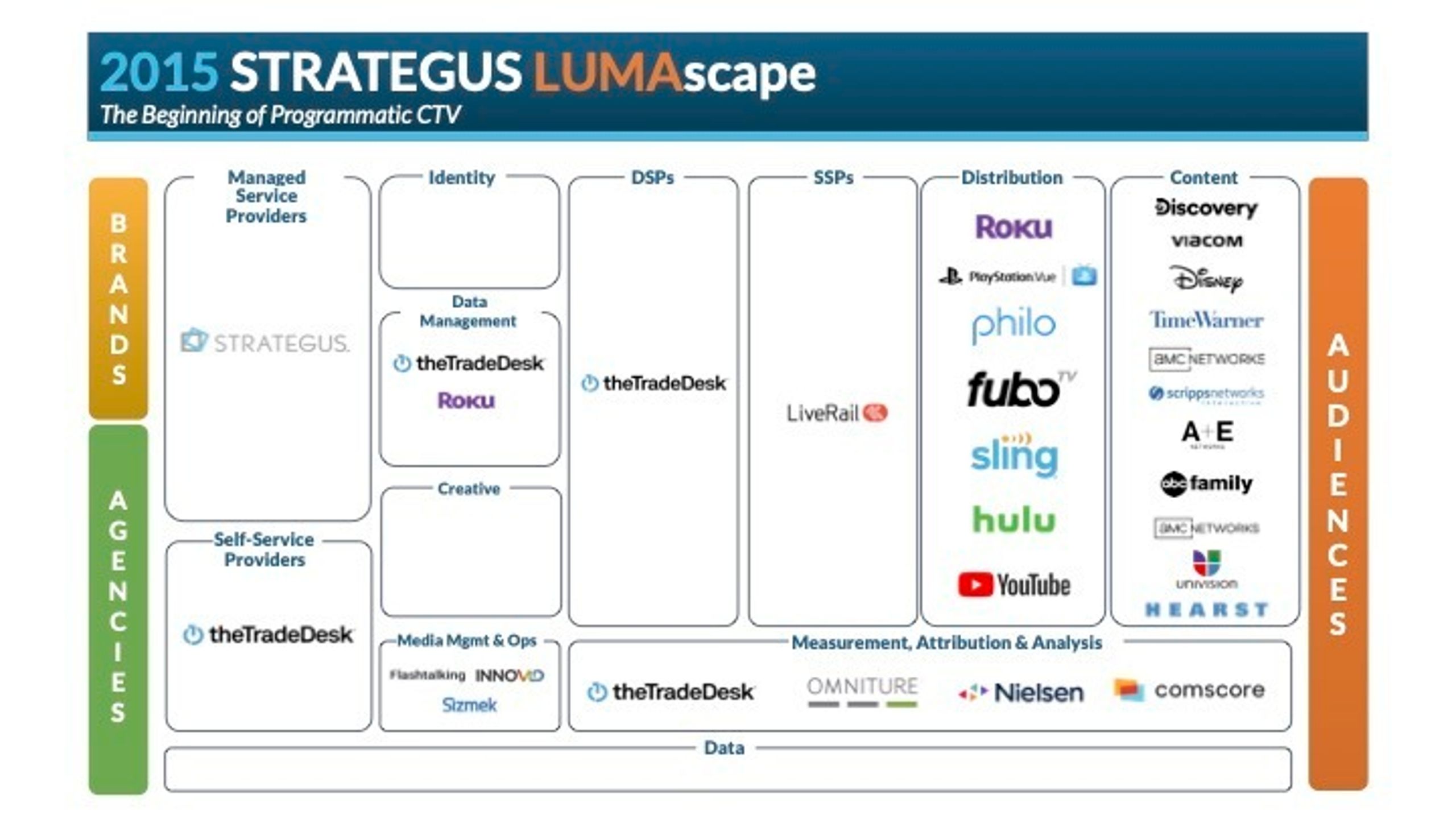
Picture courtesy of Strategus
CTV enters its infrastructure era
Of course, the path to a $38 billion valuation was anything but smooth. At the time, the market for streaming advertising was still small. Hulu was the only major streaming platform with a significant ad-supported business, while services like Netflix and Amazon remained largely subscription only.
Early on, there was a narrative that TV networks didn’t want to get into programmatic because it would commoditize and devalue their inventory.
One NBCUniversal executive warned about the danger of placing TV inventory on open marketplaces, where pricing and control could erode. Other inside agencies regarded digital inventory as a threat.
“The part that no one wants to admit is that TV networks, agencies and advertisers are filled with people who have been sitting around and doing the same thing for 100 years,” Michael Bologna, president of GroupM’s Modi Media, told Digiday in 2016. “To turn around and teach thousands of people how to do something differently is not easy and not without risk.”
Still, over the next five years, those invested in scaling programmatic CTV buying focused on building the back-end infrastructure needed to make it reliable.
In 2015, Hulu started offering programmatic ads. Four years later, it opened a private marketplace to scale automated deals. By 2020, Hulu inventory was folded into Disney’s broader upfront strategy.
Behind the scenes, server-side ad insertion — also known as dynamic ad insertion — improved delivery. Smart TVs became more common in households. Advertisers began approaching CTV more like digital video, migrating auctions, identity layers and frequency management from display and online video to the living room. The plumbing was becoming familiar, even if the screen was not.
SSPs such as Magnite, PubMatic and OpenX — all founded in the mid-2000s — opened new pools of CTV supply.
Google entered the market in 2017, bringing the scale and infrastructure of the world’s most dominant digital advertising platform.
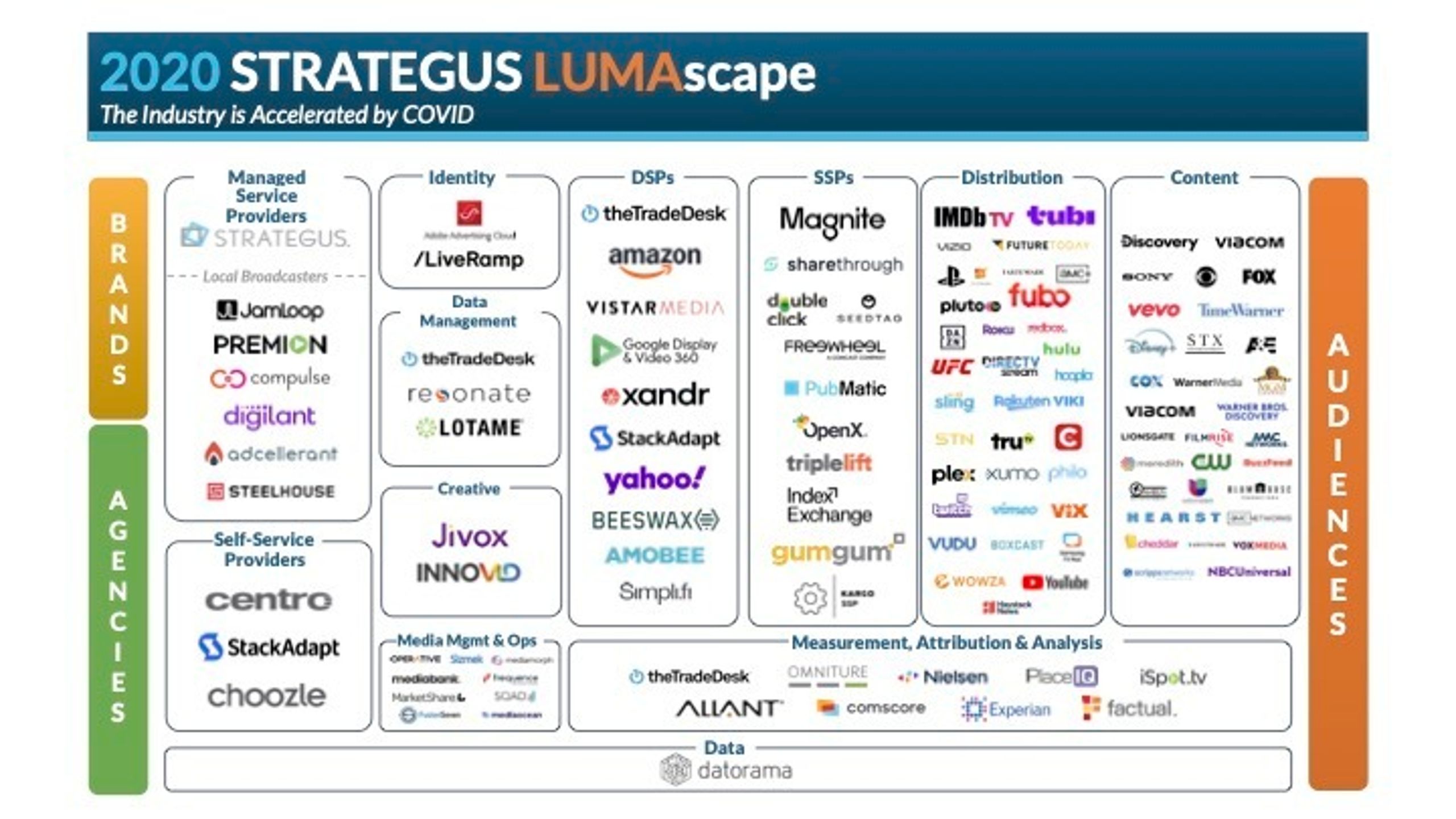
Picture courtesy of Strategus
COVID accelerates everything
Then 2020 reshaped everything.
The COVID-19 pandemic disrupted the upfront market, pushing commitments down by an estimated 15% to 20% as buyers demanded more flexibility. As billions of people were forced to stay home, streaming viewership skyrocketed. New habits were being cemented, accelerating the shift away from traditional TV.
“The COVID crisis was a catalyst for streaming growth,” Lisa Giacosa, the then-chief investment officer at Publicis-owned media agency Spark Foundry, told The Current in 2022. “What that enabled us to do was to really push even further into those spaces and put a more programmatic approach to the way we’re buying TV for that big-screen experience in the living room.”
Ad spend reflected the momentum. According to EMarketer, U.S. CTV ad spend rose from $6.88 billion in 2019 to $10.82 billion in 2020, reaching $16.7 billion in 2021.
While upfront spend bounced back in 2021, allocation strategies were shifting.
More than 40% of Disney’s upfront commitments went to streaming and interactive properties. Then-CEO Bob Chapek referred to Hulu’s ad business as a “secret weapon.”
“We led with streaming this year,” Disney’s then-president of advertising sales, Rita Ferro, said in 2021.
By 2022, the shift was unmistakable. Procter & Gamble (P&G) — the world’s largest advertiser — announced it was reallocating spend from linear TV toward programmatic and digital, with roughly half of its budget going to digital.
Peacock topped $1 billion in upfront commitments, doubling its growth. Netflix launched its ad tier, followed weeks later by Disney+.
In 2024, Disney said it had automated 50% of its advertising business and set a goal of reaching 75% by 2027.
“TV always had tremendous buying power and tremendous content, and digital brought better targeting, better measurement, better data,” Nicolle Pangis, Netflix’s vice president of advertising, said earlier this year during a panel. “CTV brings those two worlds together in a unique way. It gives you a lot of tools in your toolset.”
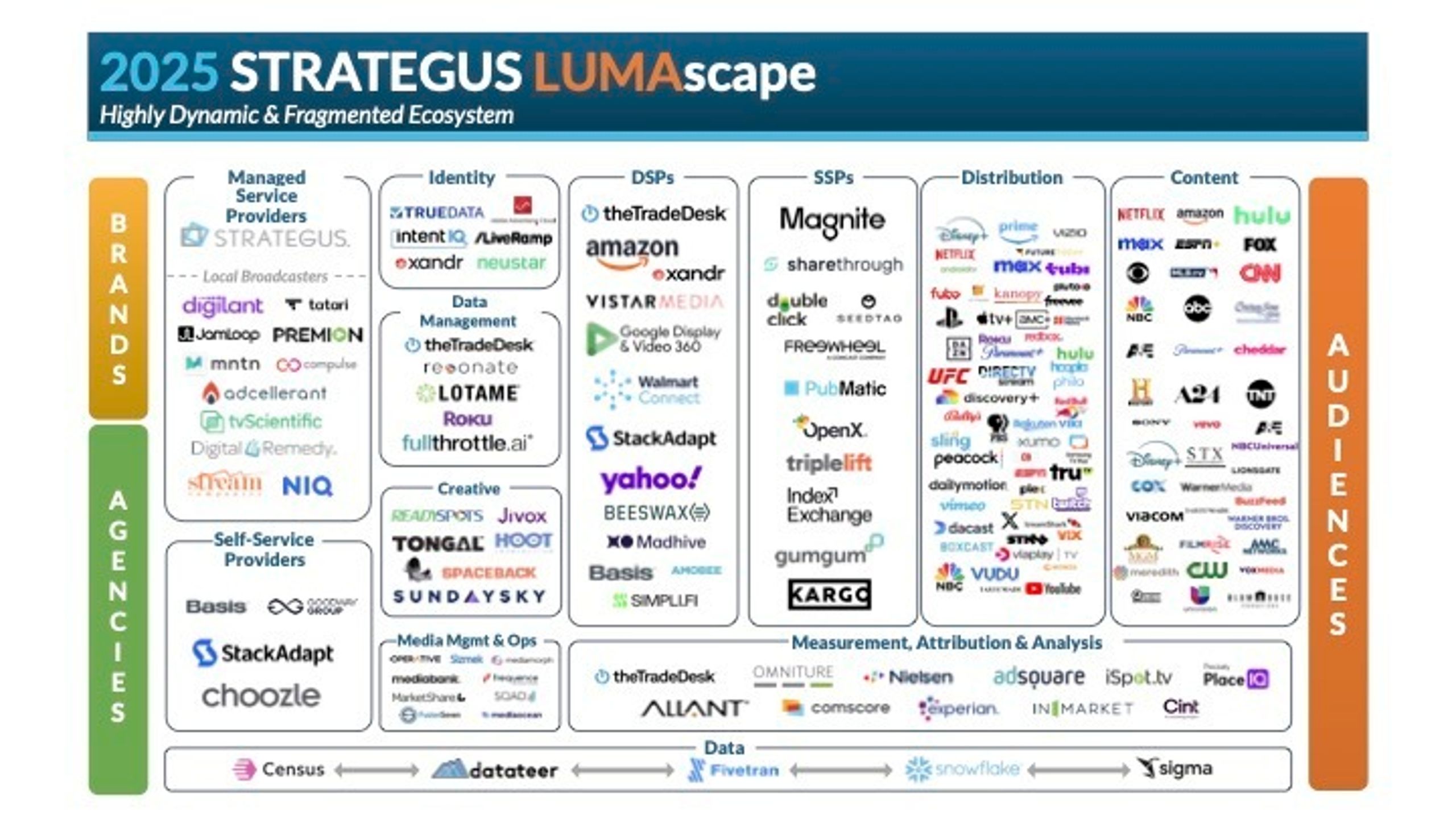
Picture courtesy of Strategus
Going from horse and buggy to automobiles
A decade after that Charlotte ballroom meeting, streaming has become a dominant force in media consumption.
Streaming viewership surpassed broadcast and cable combined for the first time in 2025, and CTV spend is projected to surpass traditional TV spend by 2027. Streaming ad dollars in the U.S. are forecasted to rise from $2.7 billion in 2017 to $42.3 billion in 2027.
For Cox, the early uncertainty now looks like the start of a structural shift for the entire TV industry.
“To say you were part of the transformation from horse buggies to automobiles, it’s incredible,” Cox said. “That’s what I look back on.”
Even as a $38 billion business has been stood up, the shift isn’t finished. Streaming platforms are battling with the likes of Instagram, Facebook, Google, YouTube and TikTok for ad dollars.
Executives at TV networks, including Disney, know those platforms often claim credit for purchases through last-click attribution. That comes as TV publishers are working to turn TV into an outcome machine like it is on walled gardens. A decade after introducing a new way to buy CTV ads, leaders are restructuring and simplifying measurement to prove its ultimate effectiveness.
The Current is owned and operated by The Trade Desk Inc.