Published May 19Edited June 17
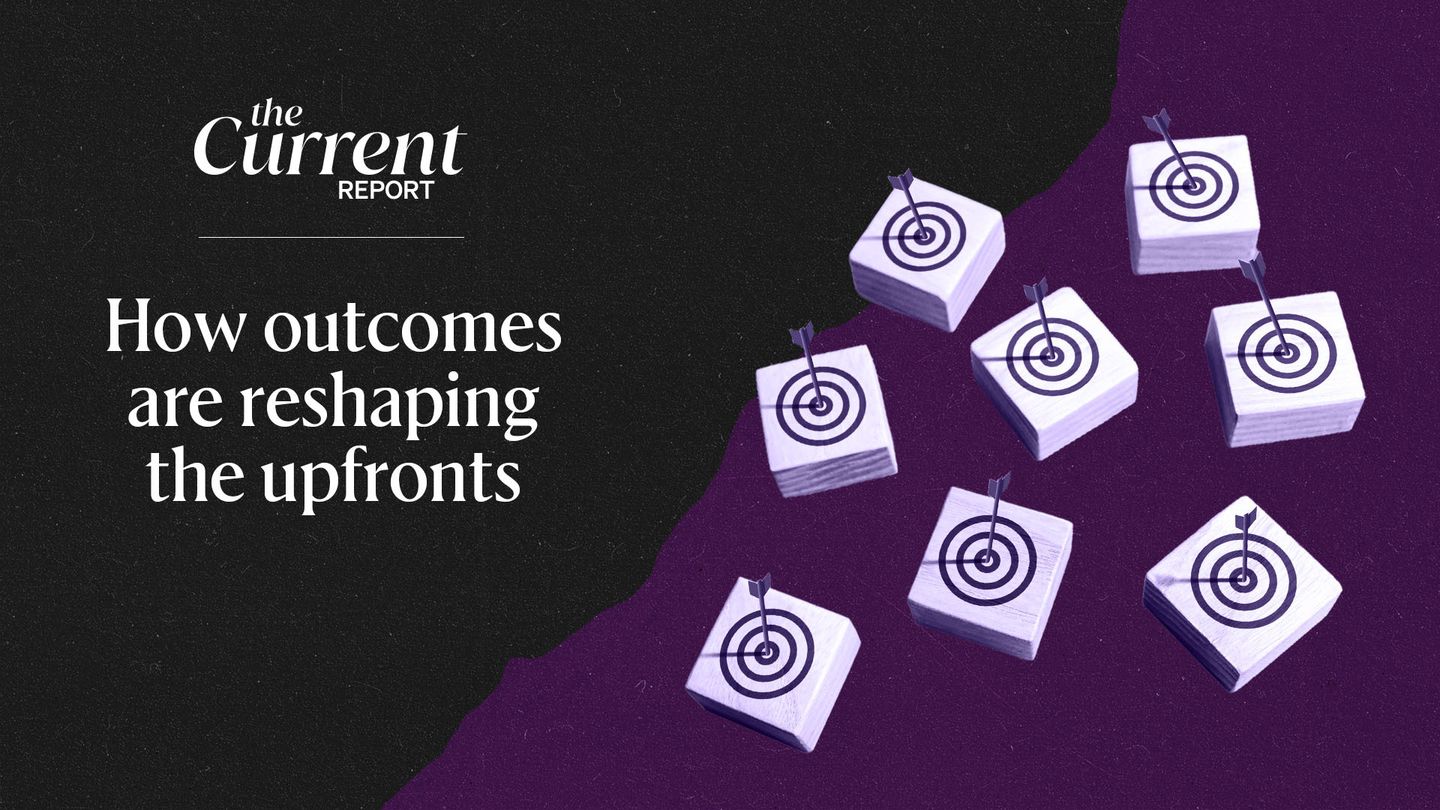
TV built its empire on reach. Now it must prove its impact. Enter outcomes.
They were on full display as the core tenet of virtually every upfronts presentation, from NBCUniversal to Netflix and Warner Bros. Discovery.
WBD is even partnering with Paramount, Fox, NBC and others to provide standardized outcome data across linear and streaming TV. The TV networks know there’s strength in numbers. By collaborating, they hope to build credibility and trust with advertisers around measurement.
Advertising changed forever in 2000 when Google launched paid search ads. For the first time, marketers could figure out exactly how many sales were driven by their ads online. Later, the engineers behind that system, Sheryl Sandberg and David Fischer, moved to Facebook and rebuilt the system there.
Now, the TV industry is becoming obsessed with recreating a similar pipeline to drive growth.
TV and streaming ad spend is flat from 2022 to 2026 at an estimated $87 billion, with traditional TV falling and streaming offsetting the gap. Meanwhile, search and social are taking a projected $296 billion in U.S. ad spend in 2026—62% of the total market, up from 50% in 2022.
Proof of performance is the number-one factor influencing planning and buying decisions, according to NBCUniversal executive Gina Reduto. She believes that TV and streaming “really hasn’t gotten the credit it deserves for driving full funnel impact.”
At its upfront presentation, NBCU announced that its in-flight measurement tool, the Performance Insights Hub, will fully roll out this fall.
“Platforms out there claim to offer real-time insights, but the reality is the results aren’t interoperable, the transparency isn’t fully there, they might not really have the actual depth of insight,” Reduto, NBCU’s executive vice president of strategy, said in December during a press briefing. “And that's the challenge we’re effectively solving, right? How do we deliver the full cross-platform picture for premium video?”
That tension between TV and the tech giants has long been apparent. Reduto’s comment is just one of the many shots over the years.
The biggest challenge for TV players in creating an outcomes framework is the complexity of working in an open ecosystem with more partners. Walled gardens like Google and Meta are direct response and can simplify their measurement with closed-loop attribution.
They also often claim credit through last-click attribution — a dynamic that recently led Kamran Asghar, CEO of Crossmedia, to tell The Current: “Because we got addicted to the idea that we could read a response, we felt like it was working.”
“The identity components [for TV] aren’t owned by one single player,” Nick Winfrey, Disney’s vice president of data and measurement sciences, said. “The data flows aren't owned by one single player. And that’s really where the latency actually comes in, which is connecting across those different systems.”
Winfrey believes that TV moving to in-flight measurement optimization represents the biggest disruption in the space, which Disney is moving towards with four principles: speed, simplicity, control and choice.
"[TV and streaming] really hasn’t gotten the credit it deserves for driving full funnel impact.”
Gina Reduto, EVP, Strategy, NBCUniversal
Still, having real-time measurement that changes media buyers’ decision-making isn’t fully operational yet. Winfrey compared the current dynamic to baking – all the ingredients are there, and marketers can bake a cake. But they’re not yet ready to run a bakery that’s producing cakes nonstop.
As the technology gets better, more data tools roll out and agentic AI ascends; measurement will become strong enough to change spending in-flight decisions, according to Winfrey.
“The more that you can get the insights into a platform or an environment where the decision-makers actually can see it and digest it and act on it quickly, that acceleration will occur.”
AMC Networks as a first mover
In 2025, AMC Networks became the first major TV network to guarantee outcomes as part of its upfront pitch. Early campaigns showed double-digit lifts among car buyers and shoppers purchasing Fruity Pebbles after ad exposure.
“While much of the industry is still moving toward outcomes-based advertising, we’ve already built it into how we transact, and the expansion of our outcomes product takes that a step further,” Evan Adlman, AMC Networks’ EVP of commercial sales and revenue operations, said during the company’s upfront presentation in March. “The upfront is where our clients put real investment behind outcomes-based advertising with AMC Networks.”
A+E joined the party this year by pitching advertisers on guaranteeing outcomes.
The actual measurement workflow
Measurement partners including iSpot, Nielsen, Comscore and VideoAmp are all rolling out products related to outcomes.
iSpot is working with AMC Networks on upfront guarantees and with Paramount on its ‘Outcomes at Scale’ initiative, which the company describes as the industry’s first business outcomes solution. Nielsen and VideoAmp both also made pushes into outcomes in 2025.
Still, because of TV’s shared responsibility between many companies to track outcomes, it complicates how much control TV networks have.
“Outcomes [within TV are] not necessarily what you have control over,” Drew Kane, chief product officer at Mediaocean, told The Current. “You can have control over the eyeballs that see something.”
There is, however, broad agreement on one point: TV networks cannot measure their own performance outcomes. An independent third party must do it.
“The challenge [and] why this probably has had a lot of stops and starts is the media owner can’t measure it themselves,” Samantha Rose, Horizon Media’s executive vice president and head of integrated investment and programmatic, told The Current. “It should be really the client and the agency and their preferred media measurement partner that owns it and is transparent with the seller.”
As TV forges on into its outcomes era, the industry is trying to build a foundation centered on transparency.
Outcomes were a core tenet of the top TV networks’ upfront pitch this year. So what’s keeping buyers and sellers from guaranteeing outcomes in an upfront deal?
June 1Chris Brooklier